Three Miami Details to Spot in GTA VI’s Extended Look
Follow the video chapter by chapter through the skyline, the Bayside waterfront, and the strip of hotels along Ocean Beach.
Where to look first in GTA VI's Extended Look
If you're trying to figure out which bits of Vice City feel like Miami, start with three places. Downtown has the skyline and a wide stretch of water in front of it. Bayside has a waterfront commercial area and a possible visual connection to the observation wheel at the real Bayside Marketplace. Ocean Beach has the compact beachfront hotel streets that are easy to compare with South Beach. Our video walks through those comparisons at 1:11, 2:57 and 4:42. Those are times in the Grand Theft Autopsy video. Rockstar's original footage has its own timeline.
Here is the quickest way to follow the comparison: pick one chapter, pause at a clear view, and make one factual note before moving on. "Towers in the background, open water in the foreground" is a stronger start than "That's definitely Brickell." The first describes what somebody else can look for. The second needs more evidence about the angle of the shot, the shape of the shore and the positions of recognizable buildings.
The best use of this guide is as a rewatch companion. Keep the video visible for the moving views, open the links to the real places for fixed references, and come back to the three sections below for what to compare. If you're only interested in the hotel facades, jump to Ocean Beach. If you want to understand the shape of the fictional city at a larger scale, start with Downtown and Bayside.
Watch our side-by-side comparison
Downtown at 1:11: start with the waterline
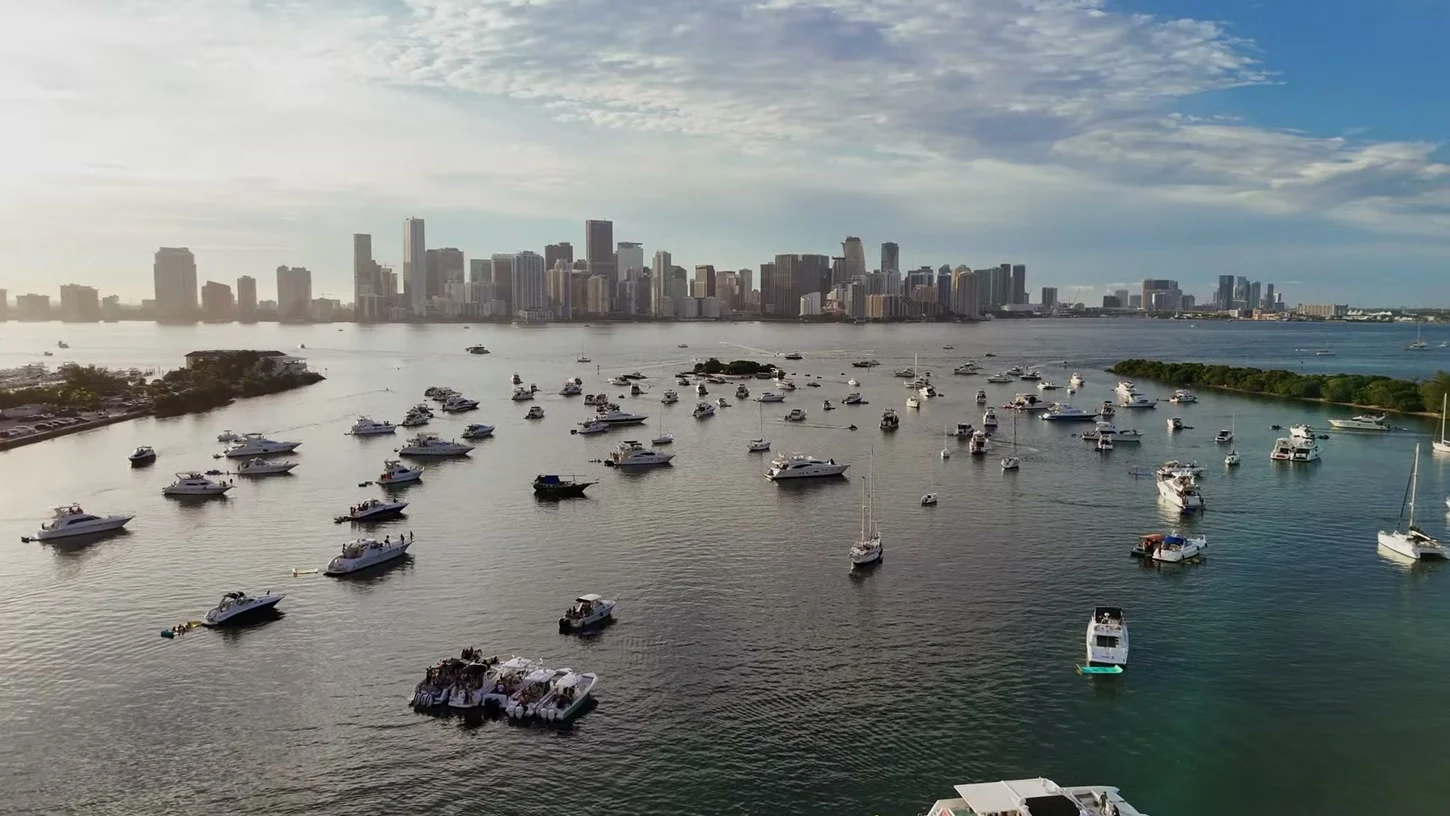
When you pause on a view of Downtown, draw an imaginary line where the buildings meet the water or the land in front of it. Then look at what separates the camera from that line. Is the foreground open water, a road, a boat or another block of buildings? See where the towers begin and whether there is a visible gap between groups of them. Those clues tell you more about the view than picking the tallest building and trying to recognize it at once.
Look at the photograph across Biscayne Bay. Small objects on the water give the viewer a sense of distance. The buildings are stacked behind them rather than occupying the whole frame. A camera in front of the same group of towers but much closer to the shoreline would make different structures visible and change their apparent size. That's why a loose match between two buildings on the skyline can fall apart when you compare the whole composition.
How to check a Brickell-looking shot
Start by comparing the relative heights and order of three structures rather than the absolute height of one. Note whether the tallest structure sits between gaps, rises from a continuous cluster or stands off by itself. Look at the lower line as well. A bank of small buildings or trees below the skyline can tell you whether the visible edge represents a road, a park or another piece of waterfront. When the shapes differ, treat that as evidence about the match.
A camera angle can hide a tower or shift the apparent order as it moves. A fictional city can also place pieces of several real neighborhoods into one useful composition. The episode proposes real-world parallels. You can repeat those comparisons with the frames it shows, but the parallels alone don't establish that Rockstar copied a specific block or street layout. Use language like "resembles the waterfront skyline" when the view supports a broad comparison but a precise address remains open.
What a second frame should show
If the first frame has a low horizon or silhouettes, find a wider or brighter shot in the same chapter. Look for the same cluster and a consistent shoreline feature. A visible bridge, seawall or approach can make a stronger check than more towers. If the cut jumps to another part of the city, use the second frame for that place instead. A cut is an editing decision. You need an on-screen connection before assuming two views are part of the same route.
Bayside at 2:57: look for the wheel and waterfront together
Bayside Marketplace is a real destination in downtown Miami. Its own site gives visitors information about attractions and identifies the Skyviews Miami observation wheel. That makes it a useful reference when you want to compare the relationship between a waterfront shopping area, an attraction and the skyline behind it. The point of starting with the place's official site is that you can verify which real destination you're looking at before weighing what the game shows.
Pause on the Bayside part of our episode and check two details at once. First, look at where the camera puts the water relative to the shops and paths. Second, look for where a recognizable landmark sits in that composition. A wheel can appear in plenty of waterfront districts. A wheel where you also see the same relationship to the shore and nearby structures is a more detailed comparison. If the features line up only from one tightly cropped shot, keep the conclusion narrow.
What a name proves and what it leaves open
The episode uses Bayside as a point of comparison. A named game district can make a useful cross-reference, especially if the name appears in official footage or copy. It still leaves a different question about how the in-game space was built. A game can move a path, merge two locations or use a recognizable name for a heavily changed area. The real Bayside site confirms real-world features, so use it to verify those. Use Rockstar's material to establish what a game shot actually shows.
You can take the comparison a little further by building a four-part note: camera position, edge of the water, landmark and what differs. The difference belongs there even if the other three parts match. It gives you a quick way to spot a weak identification. For example, a waterfront view with a similar-looking attraction but a very different street behind it may be a useful visual echo without giving you a reliable one-to-one location.
If you plan to go to Bayside
Use the marketplace's visitor information for hours, access and attractions. Take a wide view from a public area that includes the edge of the water before taking a close photograph of any attraction. The wide picture is better evidence for a scene comparison. It gives you the relationship between things. If you only have a close shot of a sign or a wheel, you may know what it is but still have no way to tell whether you're standing where a game camera was placed.
Ocean Beach at 4:42: read the hotels as a row
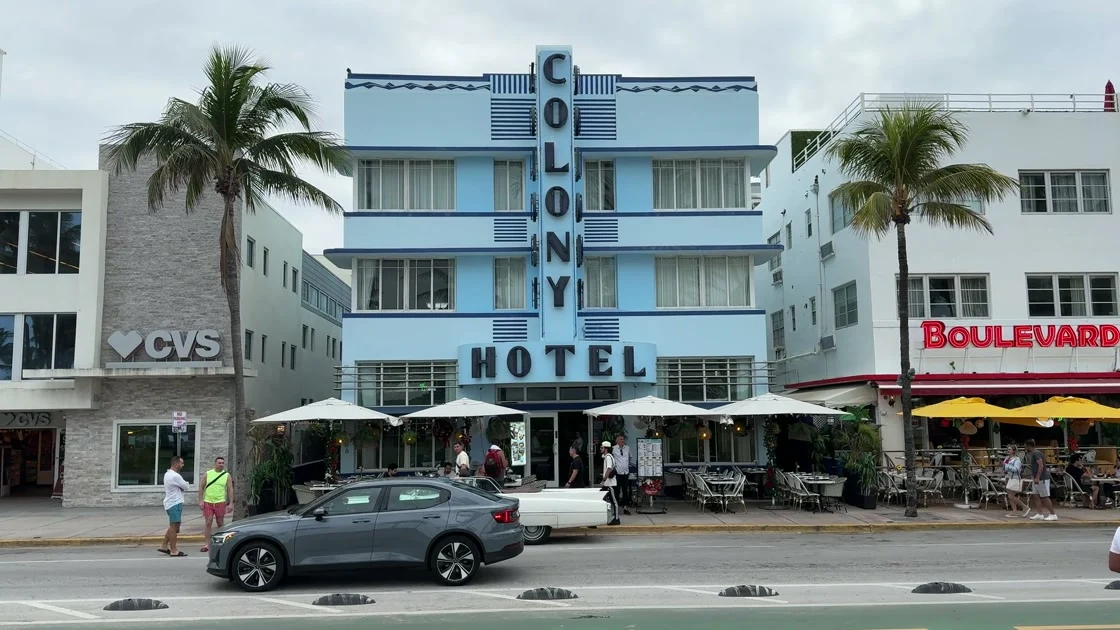
In the Ocean Beach chapter, start with the low hotel facades and the fact that you can read multiple buildings at once. A strong comparison shows not only one interesting hotel but how it sits next to other buildings, signs and the road. The City of Miami Beach's architecture guide is a good way to check the names, years and architects of the real buildings. The Colony Hotel makes a concrete starting point. The city records it at 736 Ocean Drive and credits Henry Hohauser.
Look at the photograph of the Colony Hotel first. Find the upright sign in the center and the long horizontal window lines to either side. Then turn back to the video and ask which features you can compare without reading a sign. If you can describe a similar roofline, window rhythm or sign position, you have a defensible visual point. If the resemblance depends almost entirely on a shade of blue, go back to the shapes. Real and fictional lighting are likely to change the colors you see.
Compare one wide shot and one close shot
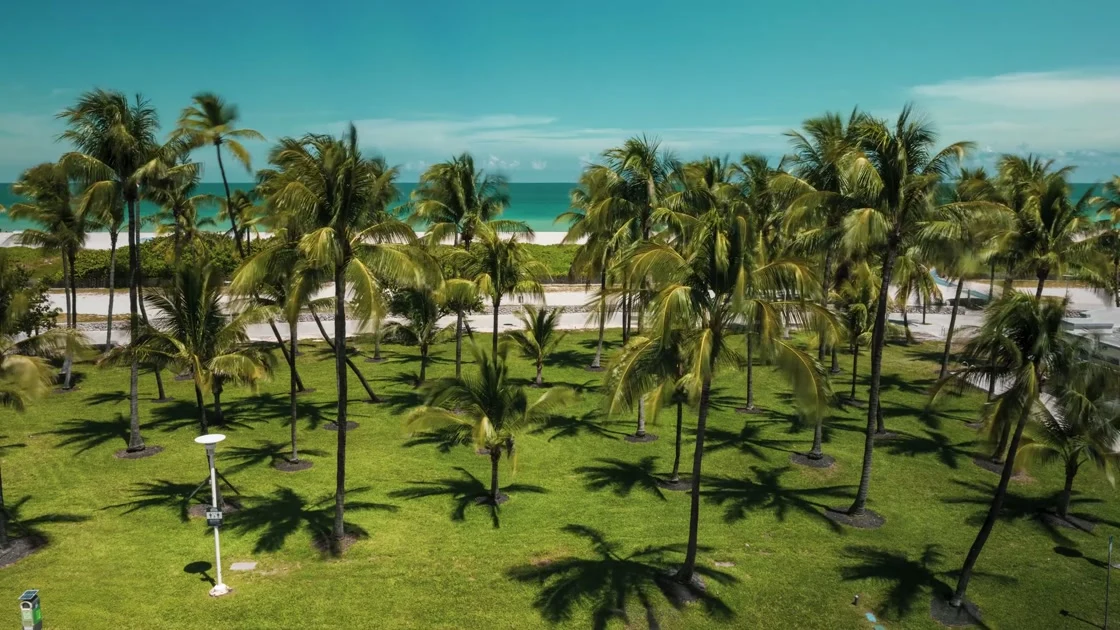
The aerial view of Miami Beach helps place the street and hotels in a wider setting. You can see the band between the water and the built area. A street shot gives you information the aerial photo cannot, such as the entrance height and the placement of the signs. Compare both kinds of image. Use the aerial view to get oriented, then move in to identify an architectural detail. Jumping straight to the detail makes it easy to forget whether you are comparing two views from similar parts of the neighborhood.
At night, the edges of a building may be easier to read than the color of its facade. Look where the light falls and what it outlines. An illuminated sign can help you identify the center of the building, but a similar sign doesn't establish that the rest of the facade matches. Our separate architecture guide has photos of Ocean Drive and explains how to test those details in Rockstar's first trailer. It is a useful second stop after watching the Ocean Beach chapter.
What changes when Rockstar makes it playable
A real photograph can show what a block looks like. A preview can show what Rockstar chose to put on screen. Neither tells you which doors open, whether a street is accessible in a particular mission or how a player will enter the district. Add that distinction to any notes you plan to share. "Visible in the preview" is a strong and checkable statement for an observed building. "Accessible during free roam" needs evidence of actual play and the conditions under which it was recorded.
This also helps when two guides disagree. One person may be talking about the inspiration for a building while another is naming the district it occupies in the game. Check the question before treating the two claims as contradictory. Look for the frame or source behind each one. The best comparison lets a reader see the shared features and decide whether the evidence is strong enough for the conclusion.
How to keep a spoiler-light comparison list
Start with three columns in your own notes: the time in the video, the visible clue and the real-world source. Add a short status for each row. "Setting resemblance" works for a general style or geography match. "Named in source" works when the game source gives a name. "Needs another angle" works when a cut or close-up leaves out important context. A viewer should be able to recreate your check from the notes, even if they disagree about the exact inspiration.
Keep plot context out of the first few lines. If an example depends on a later mission or includes dialogue that gives away a reveal, put the source behind a clear spoiler label. The skyline and architecture examples here can be compared from promotional material without giving a plot recap. For a future location comparison from our own console capture, note the platform, version and story progress before claiming the result holds for everyone.
One quick first pass is to watch Downtown, Bayside and Ocean Beach in order, then write down the strongest visual clue in each. A second pass can look for the places where the game changes something. Ask whether the change helps the scene read from a distance, makes a street easier to recognize or combines features from different places. That turns the comparison into an exercise in looking at design rather than a list of names to memorize.
Which reference to use next
Use the video chapter links for the moving comparison. Use the Bayside Marketplace site and the City's Art Deco guide for facts about the real places. Use Rockstar's original Extended Look when the question is whether a detail actually appeared in official game footage. If you are following this from the console, save the locations you want to investigate later and record the game conditions when you get there. If you are just watching the preview, keep the distinction between a visible clue and a verified location.
For a shorter follow-up, take the Ocean Drive guide and pick one building detail you can explain in a sentence. For a more exact comparison, go back to the video chapter that sparked the question and make a note with a time and source. A good summary might read, "The hotels have the low profile and strong horizontal lines of Ocean Drive. Here is where that shows up, and here is a documented real building with a similar layout." That's enough for another viewer to check the point and continue the work.
More places to investigate after the three main comparisons
Megamundo at 6:36: compare the role as well as the building
Our episode compares Megamundo with the idea of a real Spanish-language broadcaster in Miami. This is a different kind of comparison from the Colony Hotel. A broadcaster has recognizable visual conventions: a station identity on screen, a presenter in a studio, and production choices that tell you what sort of story you're watching. An observation about those conventions can explain why a fictional station feels local even if there is no architecture match.
Watch the segment once for how the station appears in the preview, then once for what the commentator points out. Keep separate notes on the design and the proposed real-world reference. The first can be checked from the frame. The second can be checked against the station's public material, but the fact that the comparison makes sense does not show who Rockstar studied while making it. This is worth distinguishing when a real station name sounds enough like an in-game name that it is easy to conflate them.
A useful comparison also looks for the meaningful change. If the fictional segment changes the look or tone of a broadcast, ask what it communicates about the world. Try describing the resemblance without using a station name. If the only remaining clue is the broad format, call the parallel an editorial reading. If the preview gives more specific details, record the frame and show the person you're discussing it with where to look.
Getting in and out at 8:17: check relationships between visible features
A shot of a road or bridge suggests how a city fits together. Read it from the foreground outward. Note what the road connects to within the frame, where the water sits, which side has buildings, and what is visible at the far end. Try moving the video forward a little to see whether the same view continues. That is the fastest way to tell whether a detail seen in one frame belongs to the next shot or whether the video cut away.
When looking at maps or street photos, compare those relationships before comparing a screenshot of the bridge itself. Plenty of bridges share the same general silhouette. A better candidate also has the right direction of approach, a similar bank on either side, and a skyline in the right position. If a wide comparison conflicts with the close one, keep both observations. The game may be using a real-looking piece of infrastructure in a different setting.
This is especially important for a guide about how to get somewhere. A visible road in a preview is worth noting for future exploration. A route recommendation needs footage of the relevant trip, the starting point and any conditions that affect access. If a street segment is shown in a cutscene, describe it as a location clue. Once you have a playable capture, you can compare the actual route with the direction implied by the preview.
After dark at 9:35: compare where people and cars gather
A daytime street view gives you curb lines, windows and the space between buildings. A nighttime view can give you something else: where a crowd gathers, which frontage is still lit and where cars slow down. Compare both before drawing a conclusion about whether a location resembles a real block. A shot dominated by a single sign will tell you less about the street than a brief wide view that includes the sidewalk and several buildings.
Notice what the light is asking you to look at. Does it leave enough of the building visible to compare its shape? Does the setting put pedestrians close to the street or pull them back from it? Is the traffic in the foreground blocking the only clue to the ground floor? Pick a frame where the evidence is visible. Watching the whole sequence in motion helps explain the intended mood, but the frame you cite should be clear enough for a reader to check the specific claim.
A practical way to share a comparison
For a social post or a note to a friend, use one sentence for what the game shows, one for what the real source establishes, and one link to each source. Use the timestamp from the version you're sharing. People who watched us on YouTube can use the chapter links here. People working from Rockstar's video need a timestamp from Rockstar's cut. If those links come from different edits, label both so the person opening them has a fair chance to find the moment.